We’ve got several guides to hybrid and electric vehicles but we know that although the market is shifting towards electric it isn’t always the right choice for everyone’s fleet.
Within a fleet the requirements for each vehicle can be different as well, so although one driver might need a small petrol car another might need a more powerful diesel engine and a third might prefer a hybrid model.
Here at Wessex Fleet when we are helping our corporate clients select a new vehicle we take into account a number of factors and we believe that you should consider the below points when adding any new vehicle to your fleet.

Now that we’ve advised on some of the key factors to keep in mind when deciding on the fuel type for a new vehicle we’re going to take a look at the pros and cons of the four main engine types; diesel, petrol, electric and hybrid.
Diesel is one of two fossil fuels that are used as fuel for traditional combustion engines.
It has been in and out of favour with governments, environmentalists and drivers over the years but we know that there is still some
The original fuel for cars and vans was petrol and it remains the most popular fuel type on the market to this day. However, we expect this to change as more drivers make the jump to electric with all the incentives that are currently in place.
E10 Petrol is petrol that contains up to 10% ethanol in it with the remainder being traditional petrol.
Ethanol is a renewable fuel that has been added to fossil fuels in order to try and make them less harmful to the environment.
Previously the standard petrol at the pump was E5 which had just 5% or less of ethanol in it but in mid 2021 the UK switched to E10 as standard. There is some concern that E10 is slightly less economical and you'll see about a 2-3% reduction in fuel economy from when you were using E5.
Drivers can still get E5 with the premium petrol options at most fuel stations, though this will be a few pence more expensive per litre.
E85 is again a blended petrol but it has a much higher ethanol content, with up to 85% of the fuel being ethanol and just 15% regular unleaded petrol.
You will not see E85 in the UK as it's no longer available commercially, but you might see it if you're driving abroad as it is commonly used across Europe.
Premium petrol has a higher octane level, octane is a chemical component of petrol and the higher the octane the better it will work in higher compression engines. Many drivers find that opting for a higher octane petrol helps them achieve better fuel economy. If you do a lot of driving then you'll likely find that paying a little more at the pump could get you a lot further on the road, depending on your driving style.
With premium diesel the octane is not necessarily higher, it will contain more chemicals that mean it will shift soot deposits and oily build-ups within the fuel system that could cause the engine to run a little slower. This can be useful if a car is not really driven regularly at high speeds over substantial distances where you might not burn all the carbon particles off and they could clog the engine and fuel system.
Depending on your drivers' needs then paying a little extra for premium fuel can be worthwhile. If you are responsible for providing them with a fuel allowance or fuel card then you will want to choose the option that makes the most financial sense and this can vary between drivers.
The government has put a ban in place on the sale of any new diesel, petrol and hybrid vehicles from 2030 in order to achieve their net zero emissions target in 2050. Because of this ban we’ve seen a lot of clients looking to move towards EV’s or hybrid models.
Hybrids are often seen as a stepping stone towards a full EV as they pair the electric battery with a traditional combustion engine, and so we’ve separated the pros and cons below into full EV and hybrid models.
Full EVs have replaced the traditional combustion engine with an electric motor and rechargeable battery in order to provide drivers with a cleaner more environmentally friendly driving experience, reduce overall noise and air pollution in the area they are driving and many more changes from the traditional car.
It’s much cheaper to charge a battery than to fill up a fuel tank.
Electric vehicles have zero emissions at the point of use, this means they help reduce pollution and improve air quality in the areas your drivers travel.
Zero emission when in use also means better company car tax for both you and your drivers and cheaper road tax for you if you purchase the vehicle outright.
There are currently government grants available to help with the purchase price of EVs, and these will also be applied to the cost if you choose to lease vehicles for your fleet. Please note that they are only applicable to vehicles where the maximum purchase price of the vehicle is no higher than £35,000.
You can also apply for a grant to help with the cost of installing charger units. There is a scheme designed for drivers to help with the cost of installation of a home charging unit if they are driving an EV or a plug-in hybrid (PHEV). Wessex Fleet are an official partner of Pod Point so can help you with any questions you or your drivers might have on installing chargers as well as help arrange this for you.
Electric vehicles have a limited distance that they can travel between charges and so this can cause range anxiety in your drivers. We recommend you advise them to look at their daily mileage needs as they will usually be able to charge the vehicle at some point during the day or overnight at home.
We know that finding a public charger can also be a worry for drivers and might be a concern for your employees. As mentioned above Wessex Fleet work with Pod Point in order to help you receive charging units, however we know that there may be a time when your driver will need to charge on the road and finding a public charger at a convenient location might be a challenge. Drivers who rent or whose existing infrastructure does not support the installation of a charging unit may also find it harder to regularly and reliably charge their vehicle.
Depending on the model and charger used then the time it might take to fully charge a vehicle can be a few hours. This might be difficult if you have drivers who regularly need to drive a substantial distance and will have to schedule charging breaks.
Due to the technology involved in them electric vehicles are typically more expensive than an equivalent petrol or diesel model. This is true if you choose to pay for the vehicle over a payment plan or you are leasing as well, the monthly payments will likely be higher.
There are three main types of hybrid vehicles available for UK drivers, plug-in hybrids (PHEVs), full hybrids (HEVs), and cars with mild hybrid technology (MHEVs).
PHEVs need plugging into a charger in order to recharge their battery while HEVs recharge on the go through technology like regenerative braking and the combustion engine when in use.
We’ve taken an in-depth look at the difference between these three types here and their individual benefits here.
Depending on the hybrid vehicle you opt for your drivers will be able to travel several miles on a purely electric range, and depending on the model’s range you can benefit from lower road tax rates because of this.
They also have lower emissions than a vehicle with a combustion engine which as well as helping reduce pollution will give you and your drivers lower company car tax rates.
As all hybrids have a traditional combustion engine as well as the electric motor when the battery is out of charge it will then switch to the engine so your drivers will not have the same range anxiety that they would with a pure EV.
A hybrid will need to be filled up with traditional fuel, either petrol or diesel, almost as regularly as a purely petrol / diesel vehicle depending on the hybrid chosen.
If you opt for a PHEV then your driver will have to charge the vehicle to make the most of the hybrid technology. This comes with the challenge of finding a convenient charger, making time to regularly charge the vehicle and can also induce some range anxiety in them.
Although hybrids are not as pollutant as traditional vehicles they do still produce emissions when not in their EV mode and so aren’t as kind to the environment or your business’ carbon footprint.
Another thing to factor into your decision is that the sale of new hybrids has been banned from 2030, and so if you do want to slowly introduce your drivers to electric technology and see hybrids as a stepping stone you will need to start transitioning soon.
With the price of diesel and petrol at record levels in March of 2022 and set to continue on the rise the cost of fuel is becoming a more important consideration for us all.
Petrol is the cheaper of the two fuel types, however if you're able to pay more upfront or monthly then charging an EV i much cheaper than having to fill up a tank of fuel.
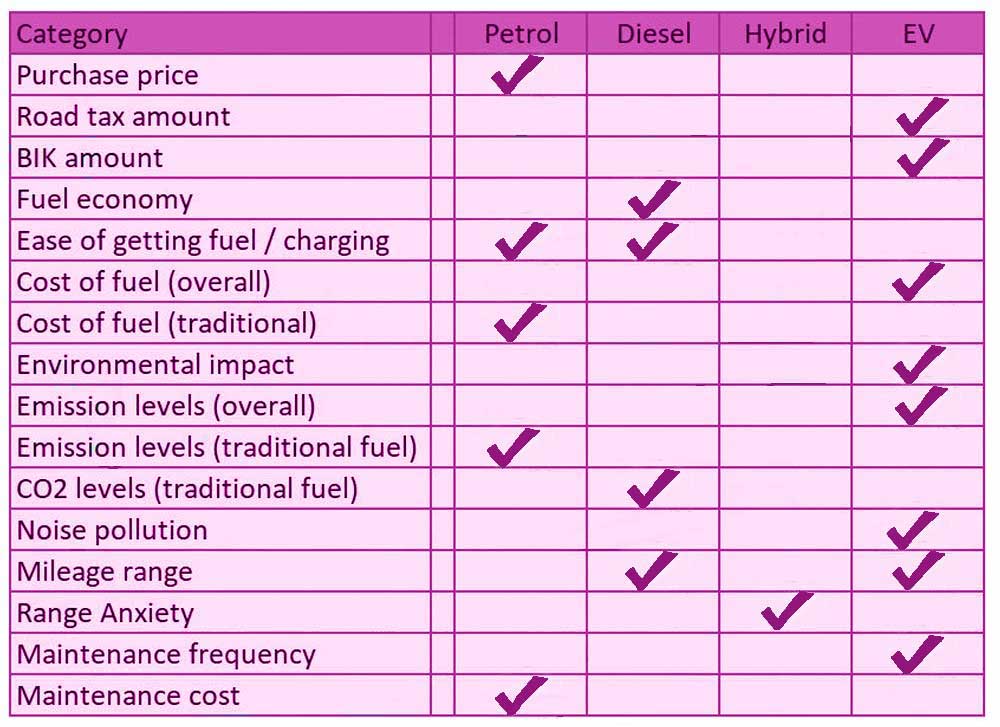
We've highlighted what we think is the best option for each of the most popular considerations when comparing fuel types in the table below.
Head back to our business guides to find more informative guides to help you decide on which vehicles are the best choice to move your fleet forward including on fuel cards and company fuel tax.